I first discovered Outer Wilds through Bangumi’s ranking list. Before that, I had almost no impression of the game at all. Seeing its striking 9.2 score made me want to find out for myself what made it so special. After around sixteen hours of exploration and reaching the ending, Outer Wilds became one of the few games I personally rate a full 10/10. I finally understood why so many players independently give it such high praise. It understands exactly what drives people forward, and it rekindles, in a truly unique way, the deepest passion in anyone who longs to explore the stars.
The rest of this article contains major spoilers. As I said above, what drives this game is your own curiosity and desire to discover. If you still know little about the world of Outer Wilds, please explore this beautiful, carefully designed solar system with your own hands first. I will retell the story from my own perspective, then share what I took away from it.
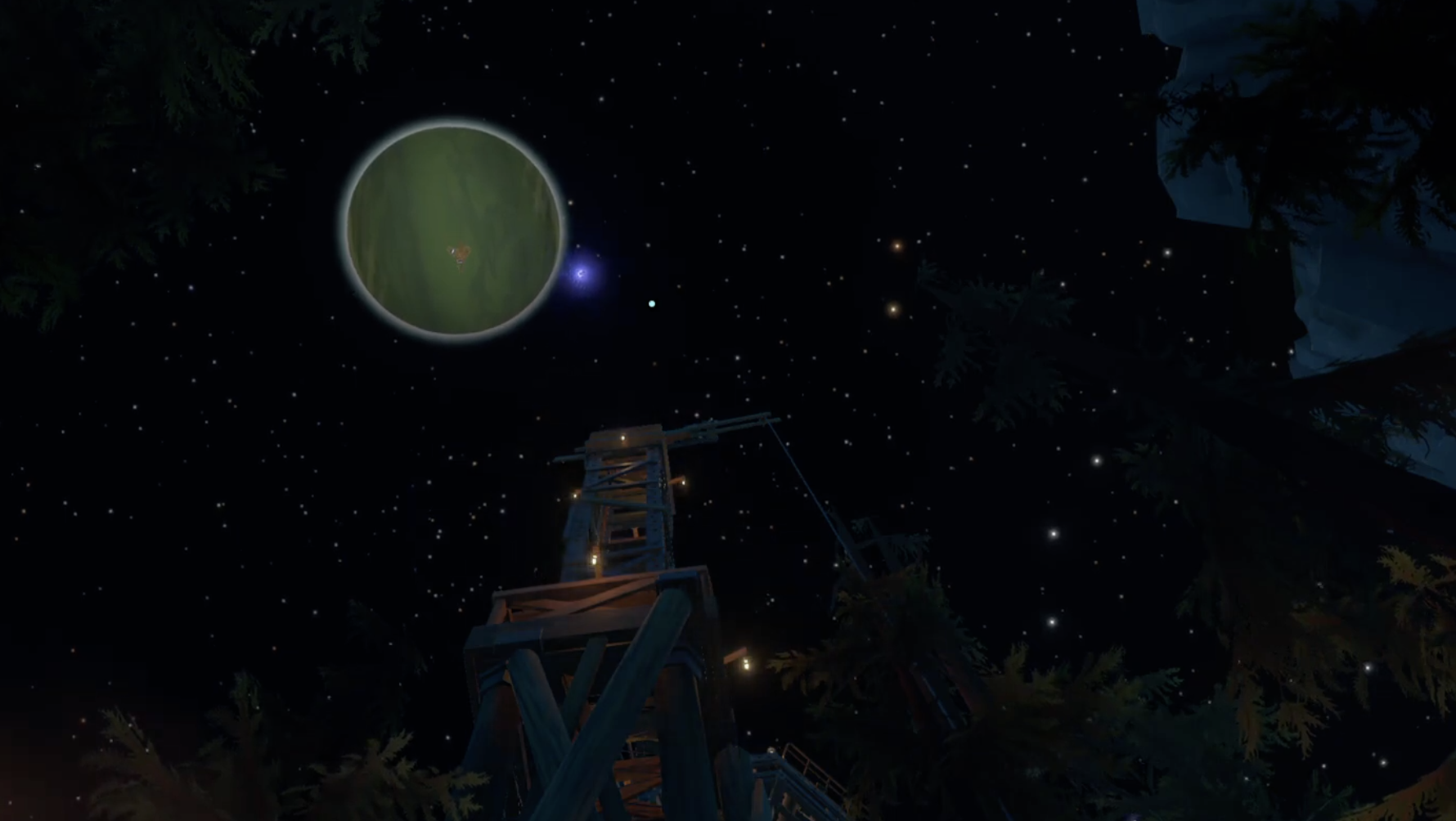
In Darkness, Toward the Infinite Deep Sky
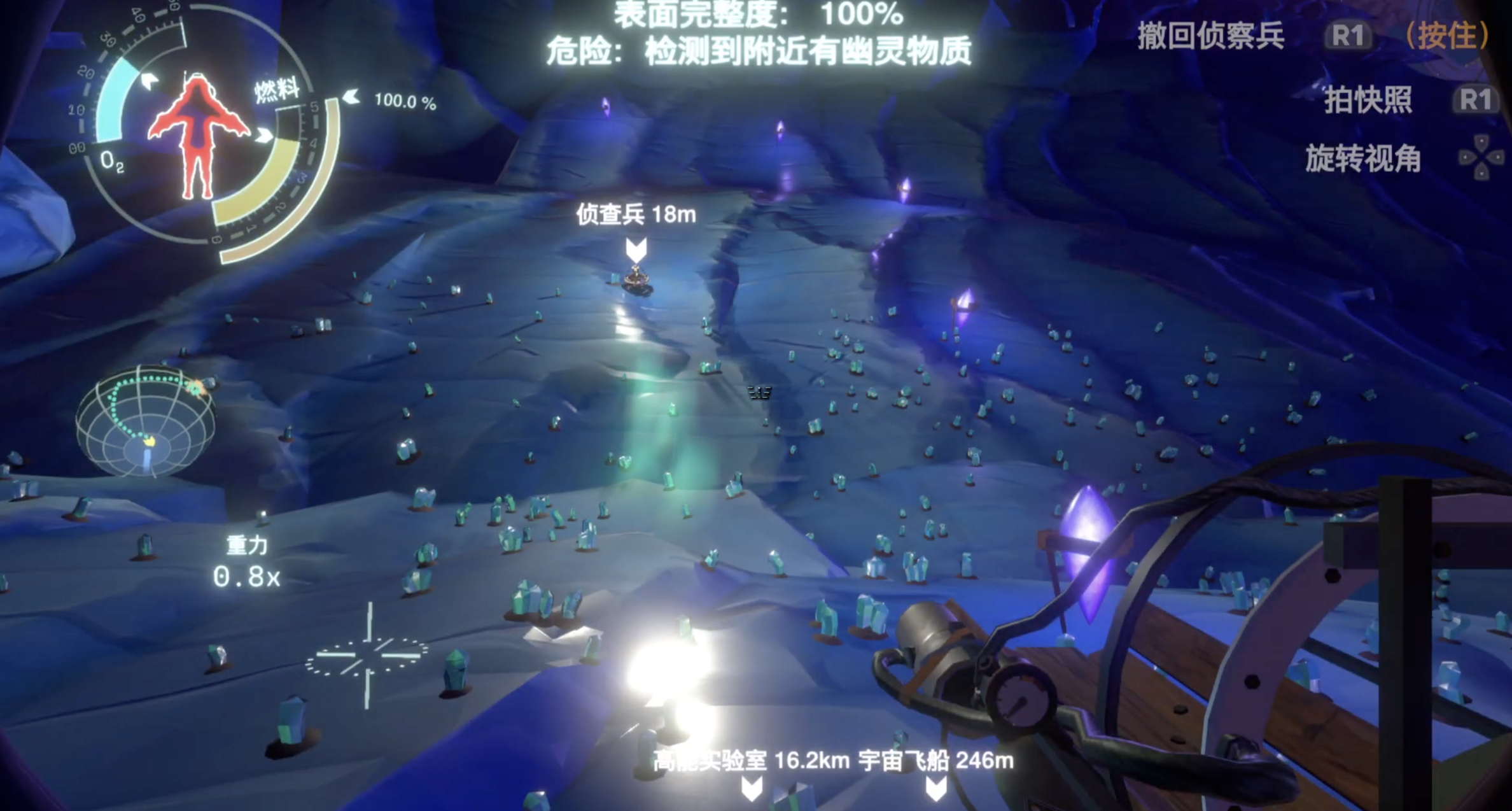
My first impression of the game was honestly bad. I expected a grand space adventure, but woke up in what felt like a tiny village. No voice acting for dialogue, unusual controls, and a ship model that felt hard to fly, plus almost zero guidance, quickly made me want to quit. Worse, on PS5 it couldn’t even hold stable 60 FPS. I had been spoiled by polished first-party titles and felt stutter everywhere.
After getting dizzy in the zero-gravity cave and then dying to ghost matter, the game just ended. I closed it angrily, thinking, “So this is the 9.2 game?” Then I started watching reviews, and they all repeated one thing: don’t read spoilers, because this may be a once-in-a-lifetime game experience. So I went back.
When I quit again, it was already dawn.
Even though my body said “go sleep,” my mind was still replaying everything that happened in-game.
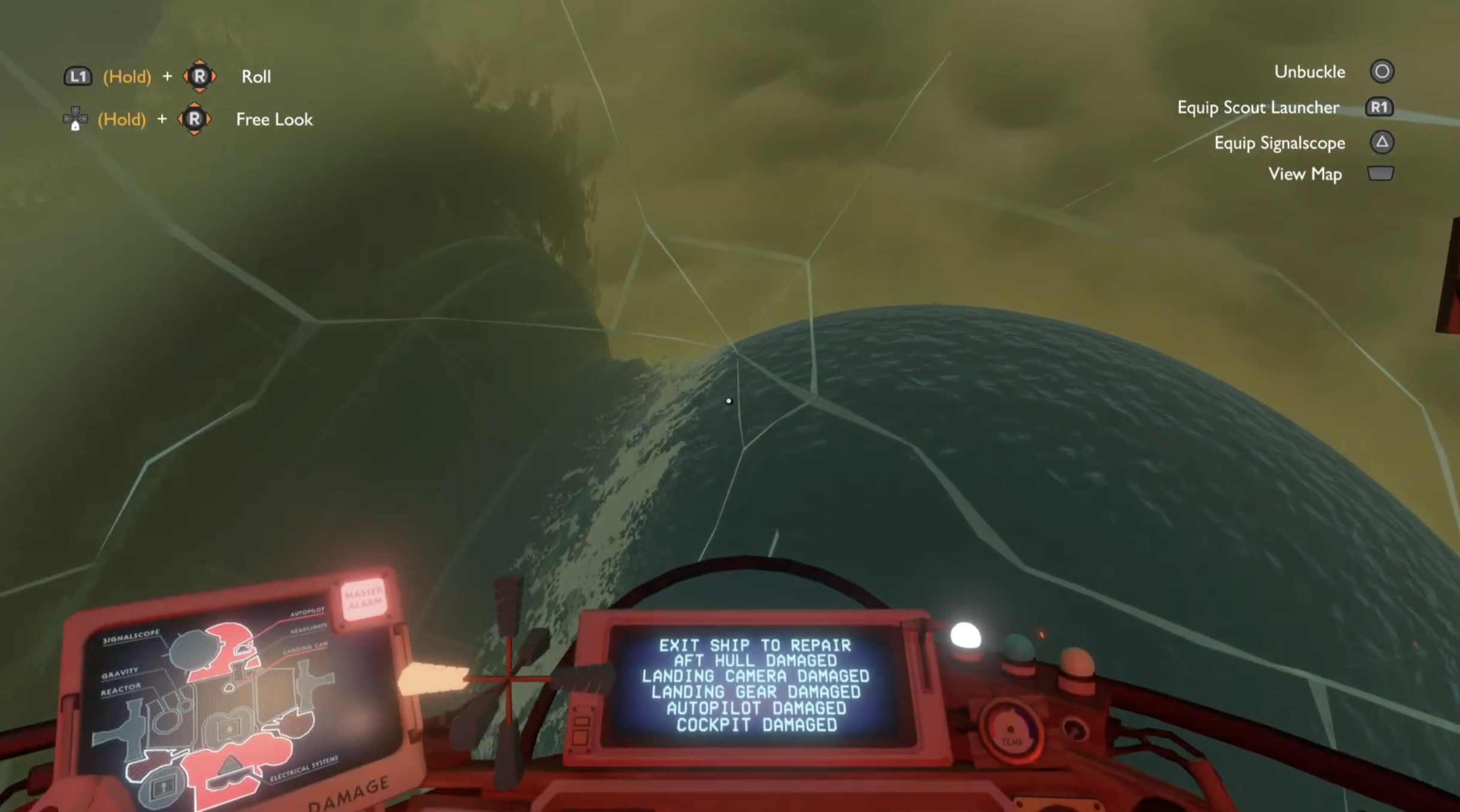
The first time I reached Giant’s Deep, I broke through the clouds and saw a water-covered planet and storms filling the horizon. Many people remember fear there. I mostly felt awe. Then my ship got caught in a cyclone and thrown into space. In that moment of shock, a brilliant galaxy appeared in front of me.
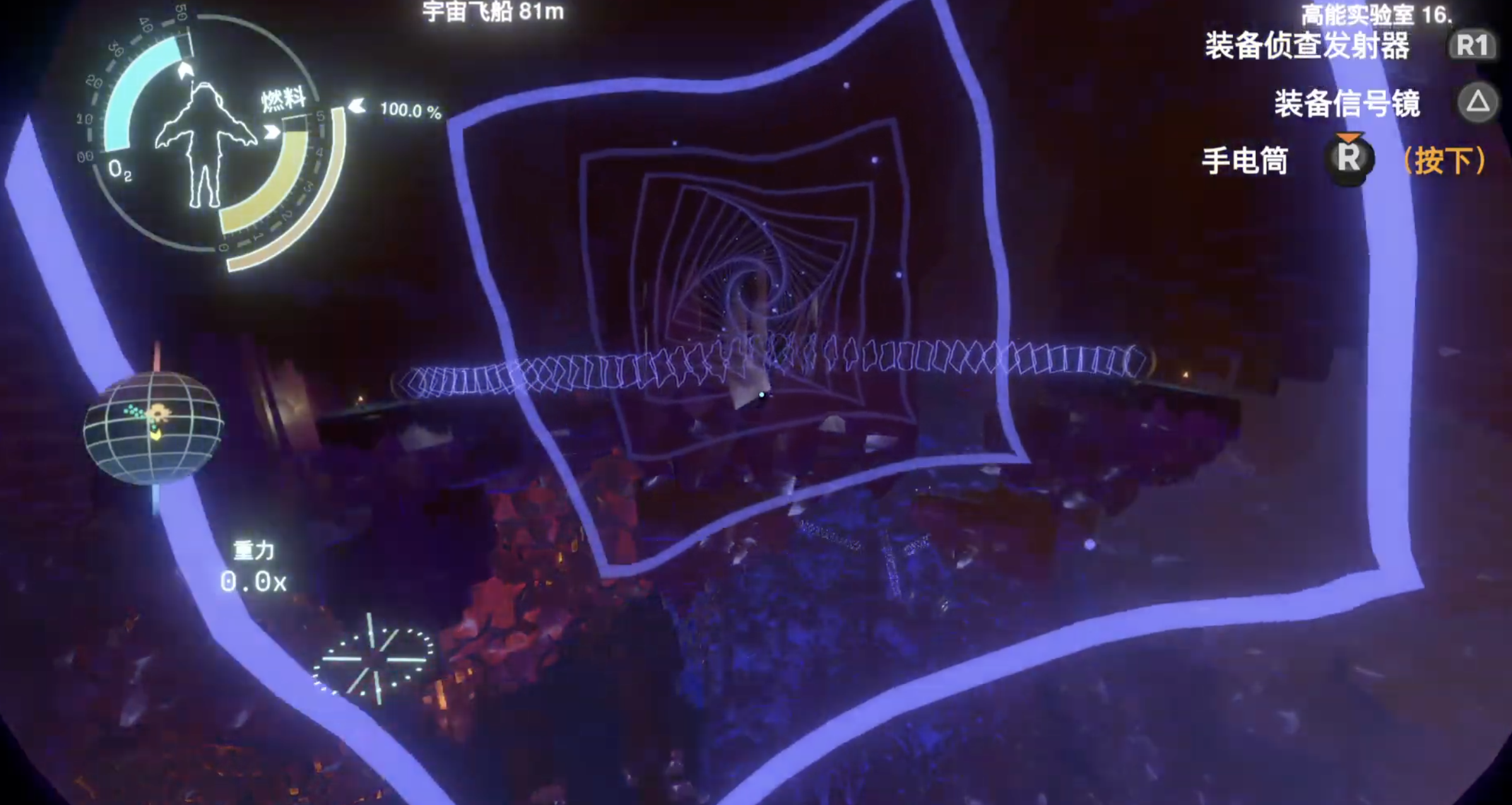
My first arrival at Brittle Hollow showed me collapsing crust and a giant black hole below. Even light near the event horizon, including parts of the UI text, was stretched into lines. Ruins of an old civilization glowed faintly. Murals, gravity cannons, hanging structures, lava, noise, collapse, and darkness blended into an unforgettable memory.
When I slipped into the black hole, I thought endless gravity would tear me apart. Instead, I emerged on the other side of the system. Floating ruins, towers, and unknown objects called out to me. Then, as the sun collapsed again in the distance and blue light filled the screen, I launched once more. This time, unlike before, I already knew where I wanted to go.
Outer Wilds tells a vast story that links civilization and individual, past and present. Stories can be told through film and novels, but this one, as interactive art, becomes history you co-create. Every player takes part in connecting clues and reaching the ending by their own will.
Story Recap
Long ago, there was a highly advanced spacefaring civilization: the Nomai. During interstellar travel, one Nomai clan detected an unknown signal they called the Eye of the Universe. Their findings suggested the Eye existed before the birth of the universe. Following that signal, they warped to this system without informing other clans where they were going.
Upon arrival, their vessel was trapped by Dark Bramble. The ship launched three escape pods, but only two escaped, landing on Brittle Hollow and Ember Twin. The surviving Nomai settled there and rebuilt their technology. Once survival was temporarily secured, they resumed searching for the Eye, but all direct localization attempts failed.
By chance, they discovered that falling into a black hole and exiting from a white hole involved a backward time offset. They built a High Energy Lab on the Hourglass Twins and eventually replicated this phenomenon. They found that rollback duration scales exponentially with required energy. To roll back farther, they needed a massive power source.
That led to the Ash Twin Project.
The project had three core parts:
- Sun Station: trigger a supernova, then harvest its energy through Ash Twin towers, powering the advanced warp core sealed inside Ash Twin for a 22-minute rollback.
- Orbital Probe Cannon around Giant’s Deep: launch probes each loop to search for the Eye.
- Memory statues and masks: transmit probe data back before rollback. They activate when the project succeeds or a fault occurs, enabling brute-force search across repeated loops.
If stellar ignition failed, extinction of the entire system was at stake. The Nomai executed the project anyway. But the Sun Station failed to trigger the sun. Later, an interstellar comet carrying lethal matter entered the system and wiped out nearly all life, including the Nomai civilization. The Ash Twin Project fell dormant. The then-primitive Hearthians survived.
Two hundred eighty thousand years later, as the universe approached its end and the sun reached late life, conditions finally triggered the project again. You (the player), by chance passing a Nomai statue at the museum, were selected as a memory bearer. When the sun went supernova, time rolled back 22 minutes successfully. The game begins.
As the memory bearer, you carry knowledge from each loop and uncover the truth behind the cycle.
Eventually, you find a damaged but functional Nomai vessel inside Dark Bramble, and discover the Eye’s precise coordinates from probe data in Giant’s Deep core. By then you understand both the original purpose of the Ash Twin Project and the fate of the Nomai in this system. As if inheriting their unfinished will, you remove the advanced warp core from Ash Twin, install it in the Nomai vessel, input the Eye coordinates, and reach the Eye of the Universe.
There, with the companions you’ve met along the way, you play a final ensemble for the end of one universe, and witness the birth of another.
Seeking High and Low to Reach the Scenery They Never Saw
To me, what makes Outer Wilds fundamentally different is its unguided open world that repeatedly converts player curiosity into meaningful positive feedback. As the developers described, every planet is hand-crafted: small, precise, and full of content that serves both exploration and narrative.
The game is built on a coherent system that changes within each 22-minute loop and then resets. Once you understand the rules deeply enough, you can reach nearly anywhere at almost any point in the loop. Even real-world physics intuition, acceleration, escape velocity, and gravity assists can help you navigate better.
One example from my run: after repeated failed attempts to track the Quantum Moon’s so-called “north pole,” I suddenly remembered what a quantum tower taught me: observing a quantum object and observing its image are effectively equivalent. I photographed the moon using the scout and finally landed on it. I still remember that rush of accomplishment.
Another example: reaching the Southern Observatory. That sequence gave me some of the game’s strongest fear and excitement. I suspect many players shared that moment of trying and failing to cross ghost matter, then suddenly discovering the answer was above all along. That release after repeated failure is exactly the kind of puzzle design I respect most.
Early exploration already gives you the game’s ultimate goals: find the Eye and explain the loop. After pointing you in a rough direction, the game gives you both clues and narrative agency, including the ending itself. You write and interpret everything yourself.
The game respects your time and curiosity. There is almost no fake “looks important but empty” environment design, including textual clues. From small clues to big clues, once the story starts to click, you realize almost no line is wasted. Everything links back to the Eye. Known clues generate unknown clues, and this cycle repeats loop after loop.
Before the mystery is fully supported by enough information, each player likely forms different hypotheses. For example, when I learned Nomai debates around the ethics of the Sun Station, I guessed the pre-loop explosion came from that station. When I finally reached it and found the truth was different, the story opened all at once into something grand and deeply romantic.
I stood there in the Sun Station, looking directly at the expanding light, feeling a legacy carried over 280,000 years, until I was swallowed by it. When I opened my eyes again, I was speechless.
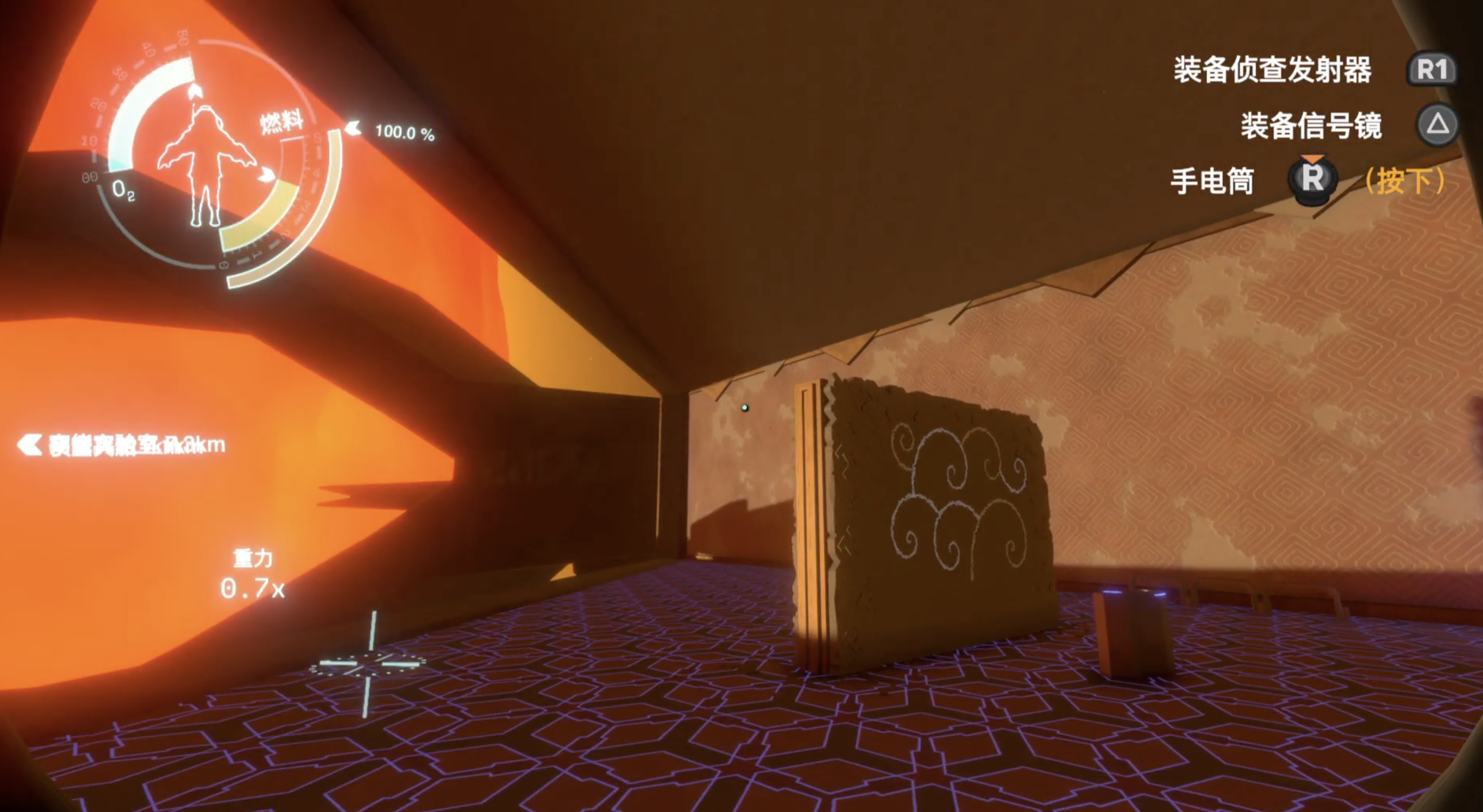
From beginning to end, the game uses no narrator and no explicit guidance, yet the ever-updating ship log keeps telling you exactly what has happened. Every time I launched again after the light faded, the courage and conviction from previous loops came with me.
Ripples from the Other Shore, Echoing in My World
I’ve loved science fiction since childhood. In middle school, Liu Cixin collections published by Science Fiction World were my mental fuel before high-school entrance exams. Back then I constantly imagined possibilities and asked questions I no longer asked for years:
Could humanity build stellar-scale ships before the sun becomes a red giant? Does the strong interaction really exist as I imagine it? After quantum transition, am I still me? Does the giant black hole at the galactic center swallow worlds every day?
After entering university, even in a place built for learning, I became increasingly unwilling to face why I was learning. I cared more about results than process, more about immediate answers than unknowns. Utilitarian thinking and “efficiency” infiltrated everything, yet I still felt exhausted, empty, and numb. Day after day, it felt like I, too, was in a time loop.
Then I met Outer Wilds.
I let myself drift in space, sometimes crashing into the sun, sometimes accidentally feeding fish inside Dark Bramble. I just wanted to know more, to see more.
Despite initially struggling to even launch and land properly in 3D zero gravity, I eventually learned to fly naturally through repeated loops. I stepped into the machinery of the Ash Twin Project and witnessed what the sand buried and revealed. Knowing its creators were long gone created a huge loneliness in me, but also stronger curiosity.
I wanted to understand everything, just like the vanished Nomai did.
We both moved toward answers without hesitation, regardless of what waited in the endless dark. Even inside a time loop, I felt my own existence more clearly than ever.
The Eye observes everyone equally and lets all visitors witness the decay and destruction of everything familiar. But does that make the universe evil? Does that make nature evil?
“If a lion tears apart an antelope, is the lion evil?” “No. Nature is not evil.”
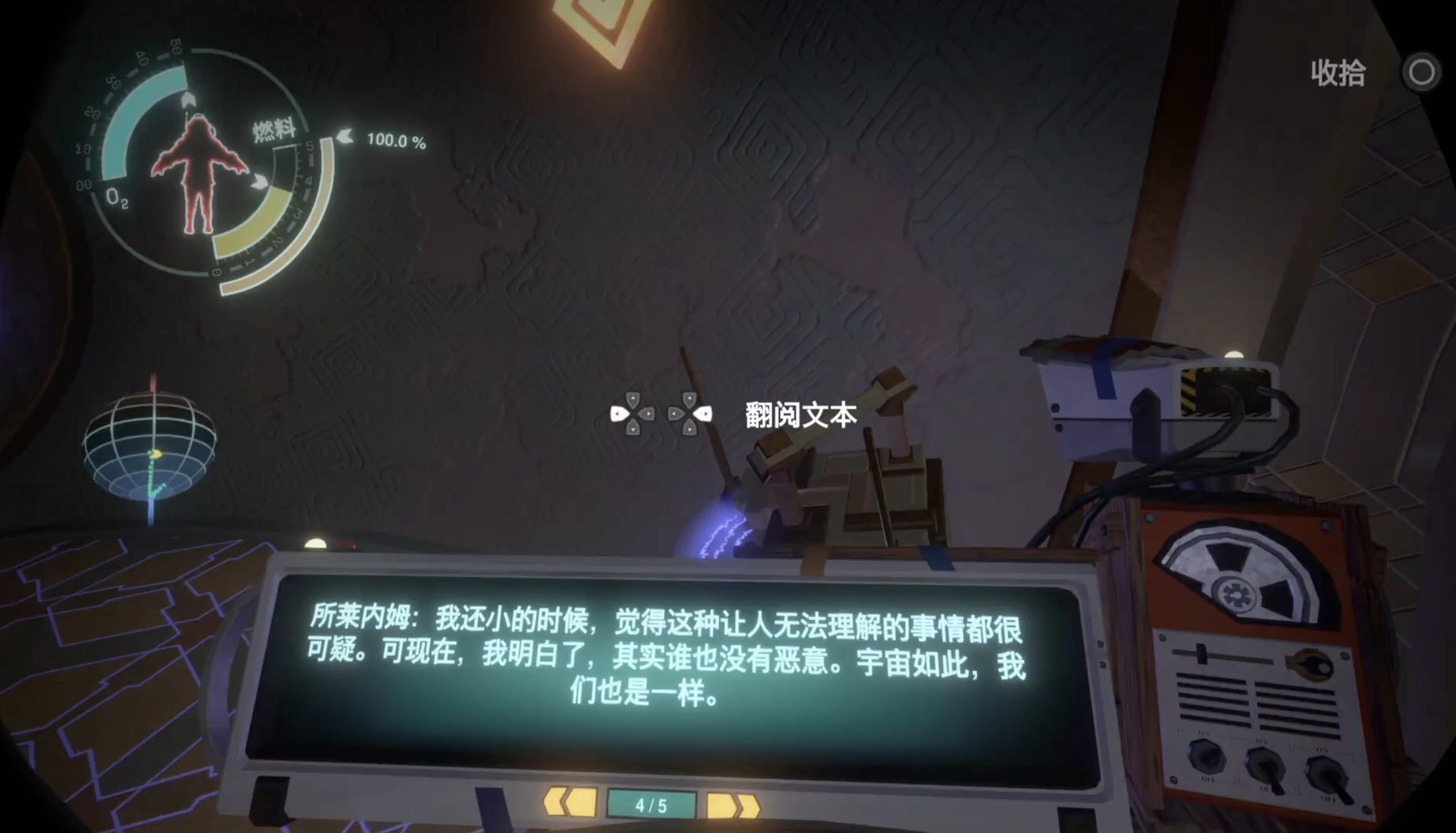
As individuals and as civilizations, we are accidents born from tiny probabilities. Our ability to think and to be curious is proof that we exist.
Even if those thoughts cannot lead us to a future in a dying universe, even if we can only witness things under ultimate laws, we can still return to the campfire together, share what we’ve seen, and play one song that belongs to us.
Where we came from, who we are, where we are going, none of these matters as much in that moment. Under the stars, what crosses time and species is a shared joy passed down among intelligent life.
I hit many frustrating roadblocks in Outer Wilds. Sometimes I wanted to open a guide. But if I keep leaving the game for answers, will I still be able to face unknowns in real life? So each time I told myself, “Try one more time.”
Looking back, that was one of my best decisions.
I started caring about process. I started enjoying process.
Those sixteen hours are a complete adventure that began and ended with this game, and a memory I will keep for life. Some questions may never have answers, but one thing is certain to me: maybe the world still loops, and life can still look gray. Yet focusing on the present does not require turning away from the stars. I can still long for things. I can still be passionate.
Even after the ending, I still remember waking up from blinding light and launching into space again and again with conviction. The passion for exploration and inquiry that reignited in me, and the endless imagination of the stars, keeps echoing in my world from the other shore of spacetime.
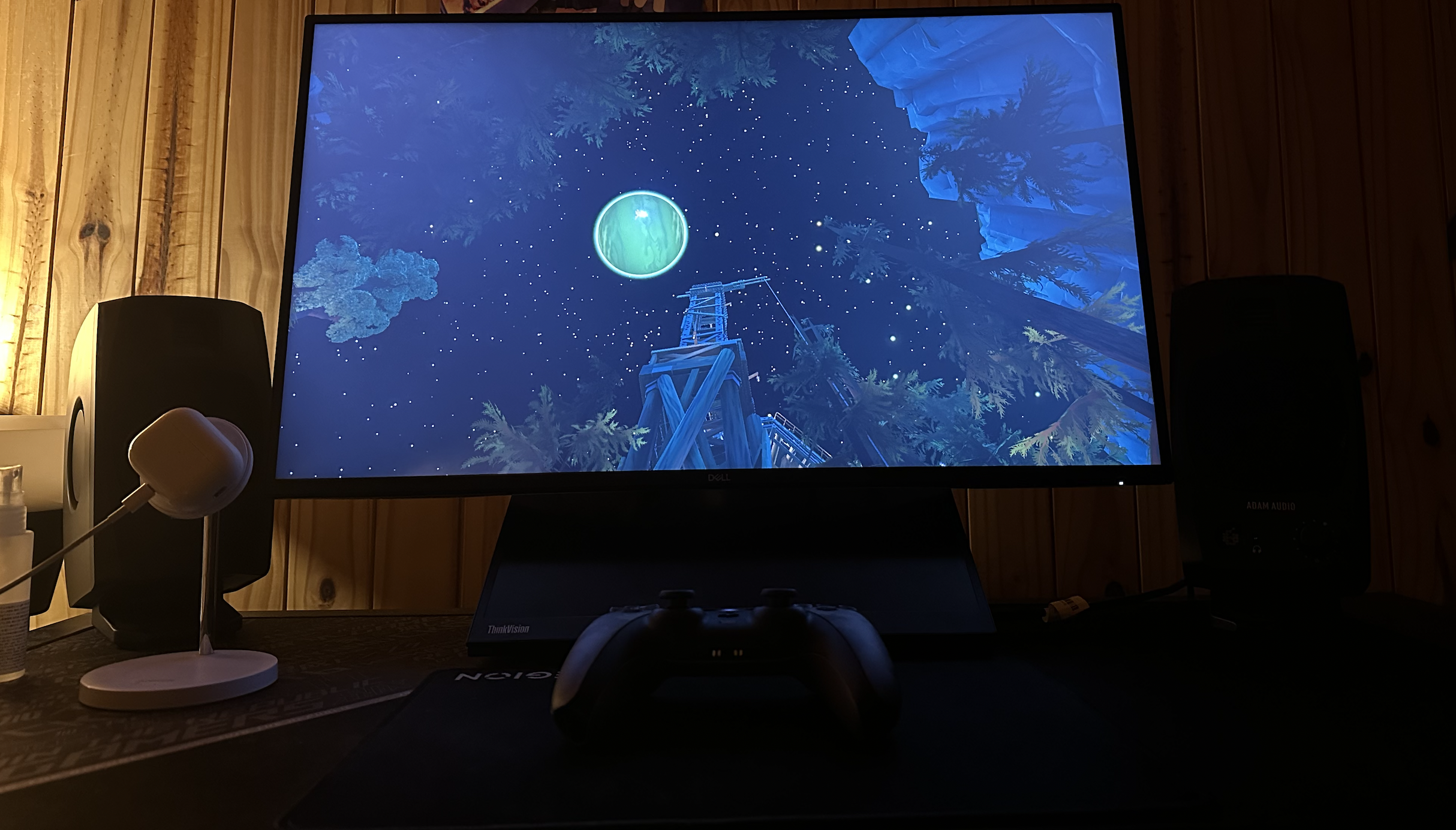
Rating and Summary
Personal score: 10/10
Strengths:
- Entirely curiosity-driven progression; information you gain is both story truth and practical navigation toward new places.
- Extremely high freedom. Your enjoyment depends on how deeply you immerse yourself in this player-driven world.
- Though open world, each planet/location is thoughtfully designed, rich in details, and internally coherent.
- Excellent stylized art direction. Species, artifacts, and architecture share consistent design language while each planet has strong identity.
- A powerful and emotionally resonant story that asks players to assemble meaning themselves.
Weaknesses:
- Noticeable frame drops and stutter on PS5 (often below 60 FPS), likely due to heavy real-time simulation across the whole system.
- Ship control on controller sticks can feel awkward.
- Not friendly to players sensitive to 3D motion sickness.
- Because progression depends fully on player initiative and textual clue interpretation, it will not satisfy everyone.
- Early-game onboarding can be discouraging.