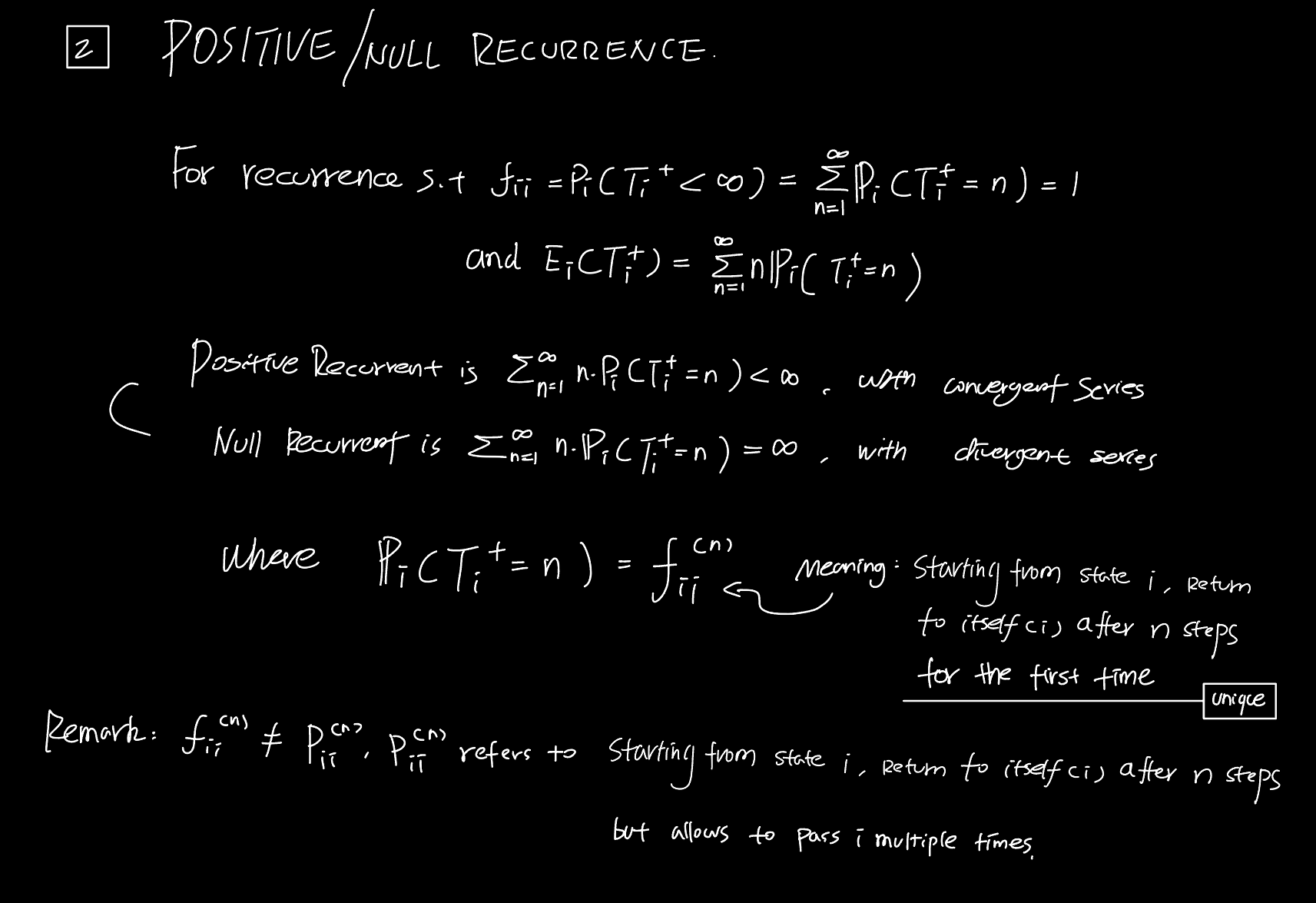
 A recurrent state satisfies
It is further classified by the expectation of the first return time $T_i^+$:
Positive recurrent:
$$ \mathbb{E}_i[T_i^+] < \infty $$Equivalently,
$$ \sum_{n=1}^{\infty} n \cdot \mathbb{P}_i(T_i^+ = n) $$converges.
Here, $\mathbb{P}_i(T_i^+ = n)$ could be further expanded using f-expansion, first step Analysis. Handwritten notes above have some directions for further investigation.
Null recurrent:
$$ \mathbb{E}_i[T_i^+] = \infty $$Equivalently,
$$ \sum_{n=1}^{\infty} n \cdot \mathbb{P}_i(T_i^+ = n) $$diverges.
A null recurrent state still returns with probability $1$, but its expected return time is infinite.
Fundamental Theorem of Markov Chain - Lemma Form
For an irreducible Markov chain,
$$ \text{there exists a stationary distribution} \iff \text{the chain is positive recurrent}. $$When the chain is positive recurrent, the stationary distribution is unique and satisfies
$$ \pi_i = \frac{1}{\mathbb{E}_i[T_i^+]}. $$Fundamental Theorem of Markov Chain
Examples
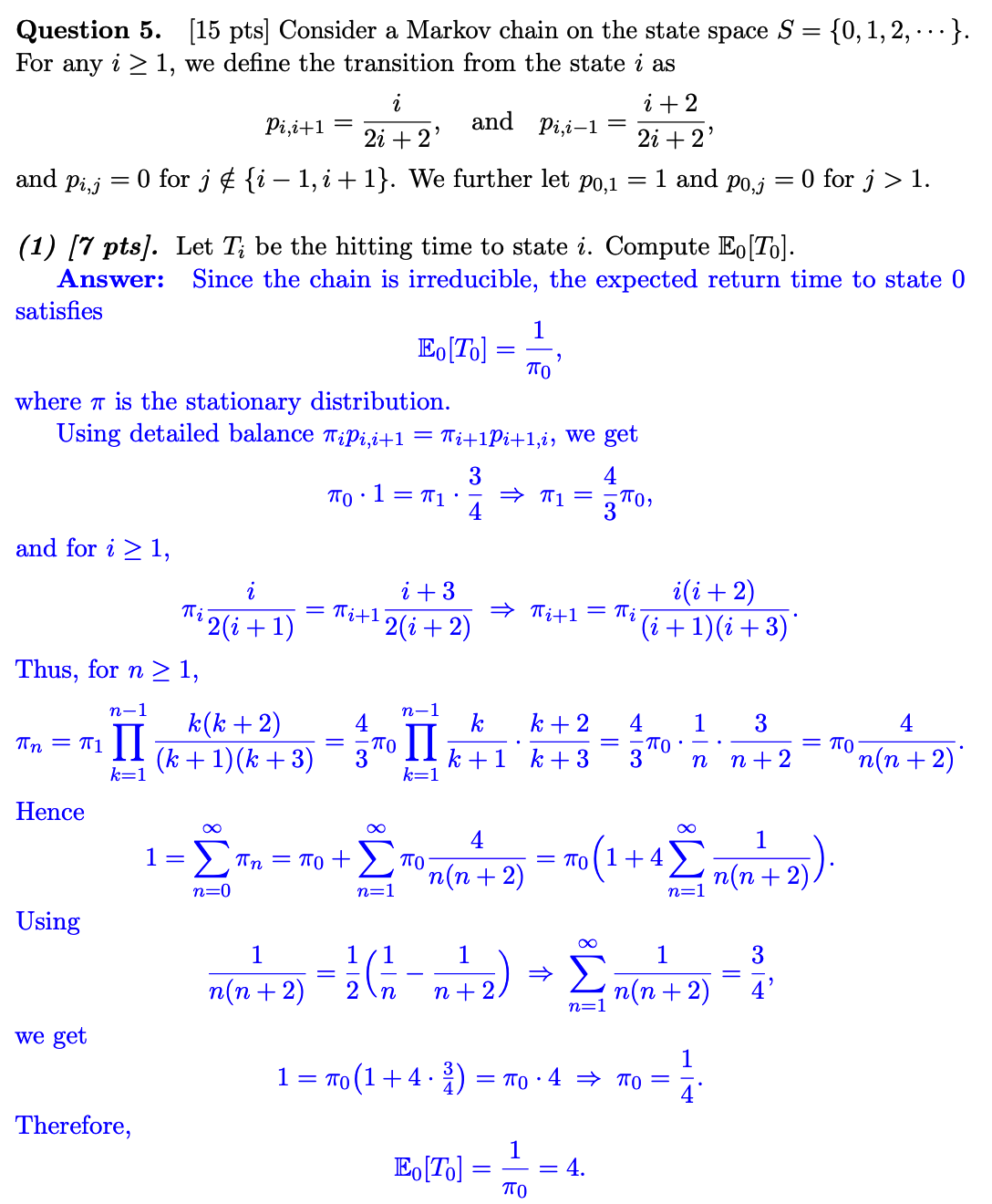
Positive recurrent: In Midterm 1 Q5, the unique stationary distribution satisfies
$$ \pi_0 = \frac{1}{4}. $$Hence,
$$ \mathbb{E}_0[T_0^+] = 4 < \infty. $$Null recurrent: The 1-D simple random walk satisfies
$$ f_{ii} = 1, $$but it does not admit a stationary distribution. Therefore,
$$ \mathbb{E}_i[T_i^+] = \infty. $$
Question 5