Weibull Distribution
The Weibull Distribution is a continuous probability distribution widely used to model positive-valued random variables, especially failure times, lifetimes, and time-to-event data.
1. Definition
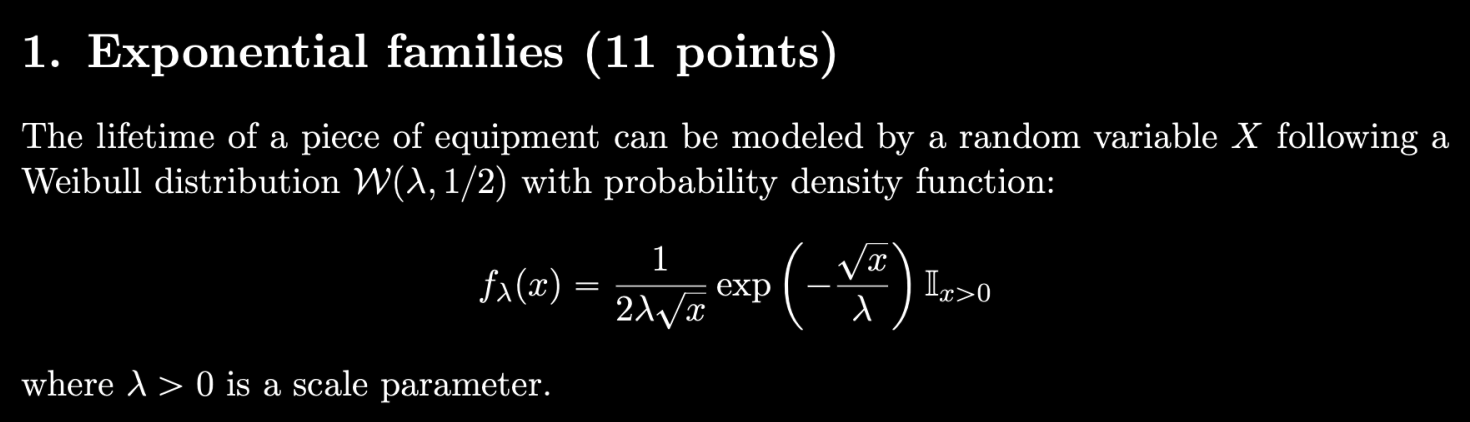
A random variable $X$ follows a Weibull distribution with shape parameter $k > 0$ and scale parameter $\lambda > 0$ if its density is
$$f(x; k,\lambda) = \frac{k}{\lambda}\left(\frac{x}{\lambda}\right)^{k-1}\exp\left(-\left(\frac{x}{\lambda}\right)^k\right), \quad x \ge 0$$and $f(x; k,\lambda)=0$ for $x<0$.
Instance in Midterm Q1
2. Distribution Function
Its cumulative distribution function is
$$F(x) = 1 - \exp\left(-\left(\frac{x}{\lambda}\right)^k\right), \quad x \ge 0$$The survival function is
$$S(x) = \mathbb{P}(X>x) = \exp\left(-\left(\frac{x}{\lambda}\right)^k\right)$$3. Hazard Function
Its hazard rate is
$$h(x) = \frac{f(x)}{S(x)} = \frac{k}{\lambda}\left(\frac{x}{\lambda}\right)^{k-1}$$This makes the Weibull distribution important in reliability analysis because the hazard behavior is controlled directly by $k$:
- $k=1$: constant hazard
- $k<1$: decreasing hazard
- $k>1$: increasing hazard
4. Special Case
When $k=1$, the Weibull distribution reduces to the exponential distribution:
$$f(x;\lambda) = \frac{1}{\lambda}\exp\left(-\frac{x}{\lambda}\right)$$5. Mean and Variance
Its mean and variance are
$$\mathbb{E}[X] = \lambda \Gamma\left(1+\frac{1}{k}\right)$$$$\mathrm{Var}(X) = \lambda^2 \left[\Gamma\left(1+\frac{2}{k}\right) - \Gamma\left(1+\frac{1}{k}\right)^2\right]$$where $\Gamma(\cdot)$ is the Gamma function.
6. Role in Inference
The Weibull distribution is a flexible model for nonnegative data and is often used in survival analysis, reliability modeling, and parametric time-to-event modeling.