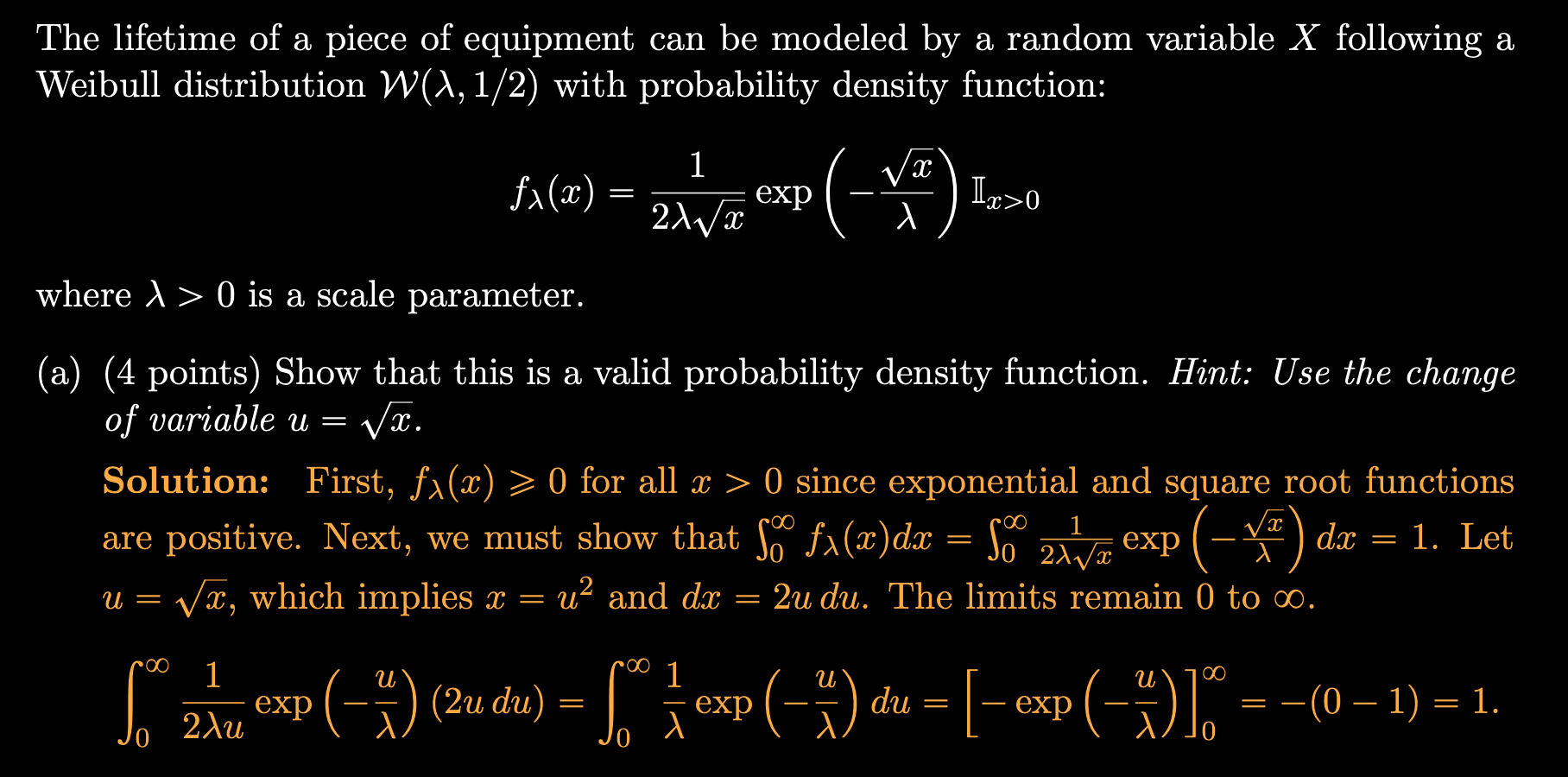
Valid Probability Density Function
A function $f(x)$ is a valid probability density function if and only if it satisfies two conditions.
1. Non-negativity
$$f(x) \geq 0 \quad \text{for all } x$$2. Normalization
For the continuous case,
$$\int_{-\infty}^{\infty} f(x)\,dx = 1$$For the discrete case,
$$\sum_x f(x) = 1$$3. Meaning in Proofs
To show that a function is a valid PDF, it is necessary to verify both:
- the function is nonnegative everywhere
- the total probability equals 1
A proof is incomplete if either condition is missing.
4. Typical Exam Usage
When a problem says “show this is a valid PDF,” the standard argument is:
- prove $f(x)\geq 0$
- compute the integral and show it equals 1
For example, one may justify non-negativity from terms such as $\exp(\cdot)$ or $\sqrt{x}$, then use substitution to evaluate the integral.
Example